

No profession shapes the built environment more systematically, or more anonymously, than architecture and engineering. Commissions are won, projects are executed, buildings are occupied, and the responsible firms move on to the next one. There are no press conferences, the work is the record. Which is why the concentration of design talent in downtown Kansas City has remained, for decades, one of the least-discussed facts in American architecture.
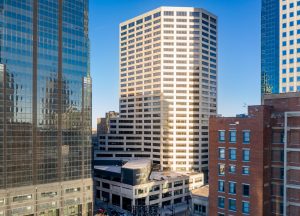
Stand at 11th and Main in front of lightwell, a 30-story tower completed in 1977 to a Skidmore, Owings and Merrill design, and within a few blocks you will find the Americas headquarters of Populous, the offices of Gensler, the structural engineering practice of Walter P. Moore, and the incoming tenancy of HNTB. Twenty architecture and engineering firms now operate in this corridor. Among them, they have produced some of the most technically complex and culturally significant buildings of the past half century: stadiums, international airports, civic institutions, and cultural facilities across six continents. The venues where billions of people have attended the Super Bowl, the World Cup, and the Olympic Games were, in many cases, designed within a few blocks of each other in a mid-sized Midwestern city.
The Kansas City Area Development Council counts 80,000 architecture and engineering professionals across 1,200 metro-area firms. The number is notable, but the lineage behind it is more instructive. Beyond downtown, Burns and McDonnell, founded here in 1898, operates its global headquarters from a 34-acre campus on Ward Parkway with more than 13,500 professionals worldwide. Black and Veatch, founded here in 1915 and now the 13th-largest engineering firm in the country by revenue, employs approximately 2,400 people across the region. Kiewit Engineering runs its operations from a Lenexa campus with 1,400 engineers, projected to reach 2,500. Together they form the broader foundation of expertise that has made Kansas City one of the most consequential engineering markets in North America, quietly executing projects of global scale that will never make the front page.
A LINEAGE, NOT A CLUSTER
The origins of the downtown concentration trace to a single firm and three concurrent commissions. In the early 1970s, Kivett and Myers completed Arrowhead Stadium, Kauffman Stadium, and the original Kansas City International Airport terminal in rapid succession, each a single-purpose facility at a moment when the prevailing model in American stadium design was the multipurpose concrete bowl. George Halas, founder of the Chicago Bears, called Arrowhead upon its completion “the most revolutionary, futuristic sports complex I have ever seen.” The profession took roughly two decades to reach the same conclusion.
HNTB acquired Kivett and Myers in 1975. The architects stayed. More than 50 independent firms emerged from that single acquisition. One group formed HOK Sport in 1983, which became Populous, now the world’s leading sports venue practice, with Tottenham Hotspur Stadium, Yankee Stadium, and the Sphere in Las Vegas among its commissions. Its Americas headquarters sits six blocks from where Kivett and Myers produced the Arrowhead drawings. BNIM, founded downtown in 1970, is the architect of record for One Kansas City Place, still Missouri’s tallest building, and served in that role for the Kauffman Center for the Performing Arts alongside Moshe Safdie. The firm has received the AIA National Architecture Firm Award twice. HOK has designed more than eight million square feet of downtown Kansas City fabric, including the Power and Light District, H&R Block headquarters, and the Sprint Center, and continues to execute major commissions here and abroad. AECOM’s sports and venues practice, with more than 60 years of Olympic master planning across six continents, maintains its headquarters in the district. Walter P. Moore has engineered more than 200 major venues worldwide from its offices at 11th and Main, including more than half of the U.S. stadiums selected to host the 2026 FIFA World Cup. JE Dunn Construction, founded here in 1924 and now the sixth-largest general contractor in the country at $6.4 billion in annual revenue, has built much of what these firms have designed across a full century of collaboration.
What presents as a geographic cluster is, on closer examination, a professional lineage in which firms have spawned firms, which have produced the next generation of practice leaders. Lineages of this kind are not assembled, they accumulate.
THE ADDRESS
Lightwell at 11th and Main has become the preferred address within the district. A $27 million renovation returned the building to its original SOM configuration, restoring sealed skylights, removing decades of accumulated modifications, and rebuilding the lobby to a standard more consistent with a hospitality project than a speculative office building. The result has drawn a notable sequence of tenants. TK Architects has occupied space here for more than a decade. Professional Engineering Consultants, a multi-discipline firm founded in 1965, relocated its Kansas City office to the 18th floor. Crawford, Murphy and Tilly, a transportation and infrastructure engineering firm with particular depth in aviation, executed a lease shortly after.
The Federal Aviation Administration has just relocated its Central Region headquarters to lightwell, occupying 80,000 square feet and administering aviation safety across Iowa, Kansas, Missouri, and Nebraska, placing its technical staff in daily proximity to the same engineering community that designs the infrastructure they oversee. HNTB will occupy space directly across the street this fall. GFT, formerly TransSystems, is relocating two blocks south.
The city’s new $1.5 billion terminal at Kansas City International Airport, which opened in February 2023 on time and on budget, completed the picture. At 1.1 million square feet with 40 gates, LEED Gold certified, the recipient of more than 30 national and international awards, and operating at a record 12.1 million passengers in 2024, it is among the most celebrated new airport terminals in the country. The firms whose lineage defines this district were the same firms that designed the original airport in 1972. The pattern across the district is consistent: independently, over an extended period, firms of significant size and national standing have arrived at the same conclusion about the same location.
KANSAS CITY IS DOING IT AGAIN
The Kansas City Chiefs are developing a new $3 billion stadium in Wyandotte County, opening in 2031. The Royals are advancing plans for a new downtown ballpark. Two major professional sports venue projects in simultaneous development within the same metropolitan area, the same condition that produced the Kivett and Myers commissions half a century ago. The Chiefs narrowed their architect selection to two finalists, both Kansas City firms. “The Kansas City region is the central hub of global sports and entertainment venue architecture and design,” said Chiefs President Mark Donovan. “We didn’t need to go far.” The Royals’ ballpark is being designed by Populous. No other metropolitan area could staff both commissions from local practice without importing talent. That is not a promotional claim, it is a straightforward statement about where the expertise resides.
Before either stadium breaks ground, the city will host its most consequential sports moment in decades. Kansas City is one of only two 2026 FIFA World Cup host cities with four national team base camps, and the only one hosting three Pot 1 teams. Argentina, the defending world champions, England, the Netherlands, and Algeria have all chosen Kansas City as their tournament home, drawn in part by the region’s $650 million investment in soccer infrastructure over 15 years. The city expects 650,000 visitors across six matches at Arrowhead Stadium. Many of the national stadiums these teams call home were designed by firms operating within a few blocks of each other in this city.
The surrounding investment has been reinforcing the district for years. A $370 million deck over Interstate 670 will restore the physical connection between the Crossroads Arts District and the urban core. The KC Streetcar links the riverfront to the Country Club Plaza. More than 1,800 new residential units have brought the downtown population past 30,000. None of this has required announcement. When Hallmark’s Donald Hall commissioned Crown Center in the late 1960s, he engaged Edward Larrabee Barnes, Harry Weese, Henry Cobb of I.M. Pei’s firm, landscape architect Dan Kiley, and Warren Plattner, designer of Windows on the World. The talent has always found its way here. Kansas City has simply gone about its work.
Firms are no longer merely maintaining a Kansas City presence. They are relocating headquarters, expanding floors, and committing to long-term leases. The market offers a cost structure that allows firms to recruit and retain professionals that comparable coastal offices cannot. Proximity to clients, contractors, and peer firms, in a field where project relationships are built over years and not quarters, is a structural advantage that appears on no ranking but shapes every significant commission. Industries rise and fall. Companies relocate. Architecture and engineering in Kansas City has done neither. It has grown quietly, steadily, and to a scale that is only now beginning to be understood as the competitive advantage it has always been.
THERE ARE 36 ARCHITECTURE & ENGINEERING FIRMS LOCATED IN DOWNTOWN KANSAS CITY
Large Multidisciplinary Engineering & Infrastructure Firms
Garver
Tetra Tech
Olsson
HNTB
GFT
Kimley-Horn
WSP
IMEG
Shive-Hattery
GBA
Structural Engineering Specialists
Walter P. Moore
Thornton Tomasetti
Structural Engineering Associates
MEP / Building Systems Engineering
Henderson Engineers
Dialectic
M E Engineers
Apex Engineers
Jedson Engineers
Architecture / Design Firms
HOK
BNIM
Gensler
Perkins&Will
Treanor
Rosemann
Hollis + Miller
GastingerWalker&
Crawford
Sports, Entertainment & Specialized Architecture
Populous
Regional Architecture & Engineering Firms
B+A
Clockwork
STRATA
Wellner
Davison
SFS
Environmental / Water / Civil Specialists
Great River Engineering
Helix
By Tim Schaffer, AREA Real Estate Advisors